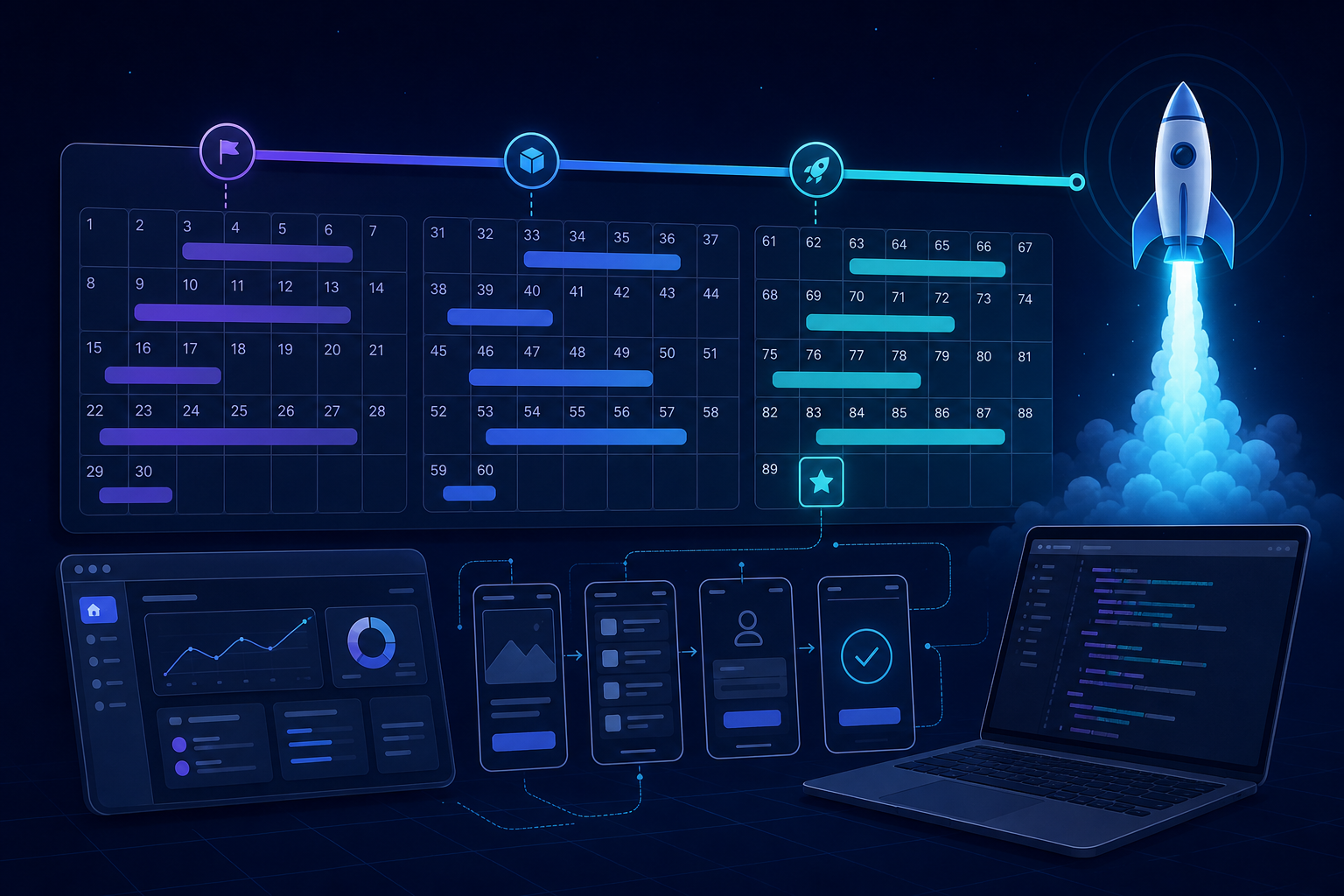
Most SaaS MVPs fail for one of two reasons: they ship too much, or they ship on a foundation that cannot survive real users. A credible MVP in 90 days is not about cutting corners — it is about choosing the smallest surface area that proves demand while engineering for the second hundred customers, not just the first ten.
At Vedas Codetech we ship startup MVPs on a repeatable cadence: multi-tenant auth, billing hooks, admin dashboards, observability, and one killer workflow — nothing else until validation lands. This article is the playbook we use with founders before a single sprint starts.
Week 1–2: Define the one workflow that must work
Every successful MVP answers one question: can a specific user complete one valuable job end-to-end? Not three features. Not a platform. One job — onboard, configure, execute, get a result they would pay for.
- 1Write the job story in one sentence — who, what outcome, why now.
- 2List every step in that job; cut anything that is not on the critical path.
- 3Define success metrics: activation, time-to-value, and one retention signal.
- 4Pick your tenancy model early — single-tenant demos lie; multi-tenant reveals truth.
Week 3–6: Foundation before features
Founders often rush to UI. Engineering teams that ship fast do the opposite: lock auth, roles, audit logs, error handling, and deployment first. These are cheap to add now and expensive to retrofit after launch.
- Auth + org/workspace model with invite flows.
- Stripe or Paddle integration stubbed — even if billing starts manual.
- Structured logging, error tracking, and basic health checks.
- CI/CD to staging and production with rollback.
- Seed data and demo accounts for sales conversations.
If a feature does not directly support your one core workflow or your ability to observe it in production, it waits until after launch.
Week 7–10: Ship the core loop
This is where velocity matters. Use proven patterns — Next.js or similar for web, Postgres for data, a job queue for async work — instead of novel architecture. Your differentiation is the workflow and domain logic, not your ORM choice.
Week 11–12: Harden for real users
Load testing is optional at MVP stage; abuse protection is not. Add rate limits, input validation, backup strategy, and a support inbox wired to your error tracker. Run five real onboarding sessions and fix what breaks.
When to bring in a product engineering partner
If your founding team lacks full-stack depth, or you need to parallelize design + backend + infra, a dedicated startup engineering partner beats hiring three freelancers. Look for teams that ship multi-tenant SaaS regularly, document architecture decisions, and hand you a codebase you can grow — not a prototype you throw away.